Descrizione del prodotto
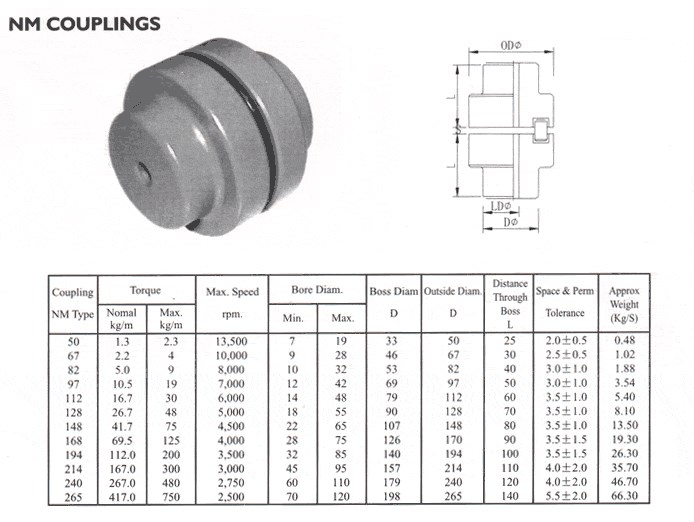
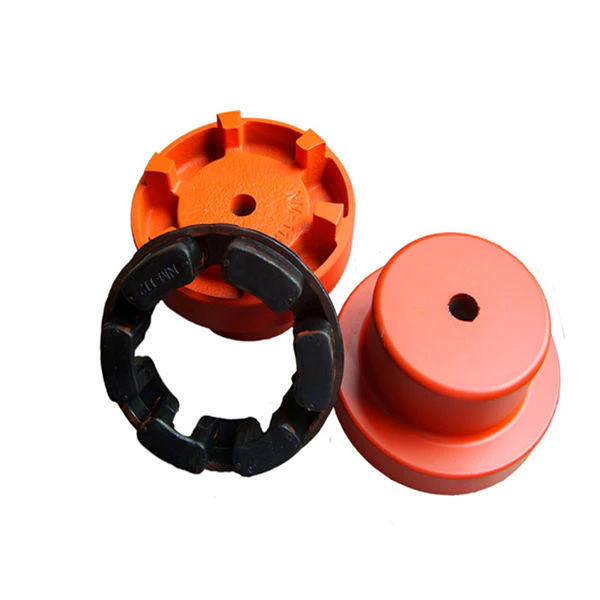
NM Coupling, NM Rubber Coupling Elements, NM Rubber Spider
| Materiale: | NBR, CSM/SBR | Colore: | Nero |
| Tensile Strength: | 12 MPa | Durezza: | 80shore A |
| Allungamento: | 350% | Densità: | 1,25 g/cm³ |
| Misurare: | NM50, NM67, NM82, NM97, NM112, NM128, NM148, NM168, NM194, NM214, NM240, NM265 |
accoppiamento NM
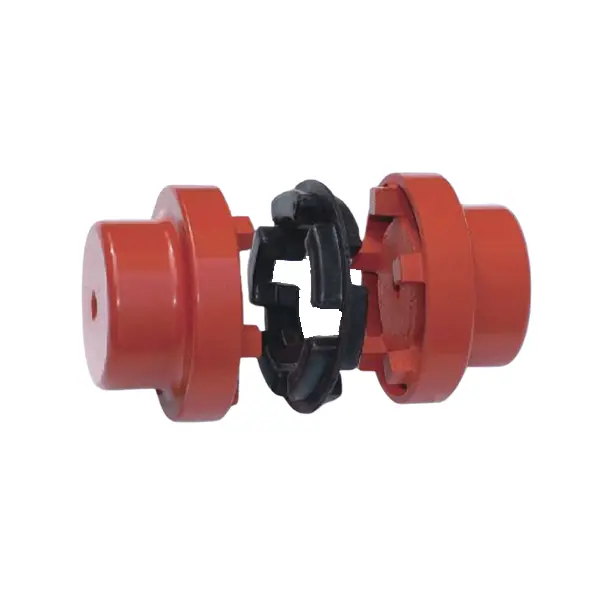
Il modello tipo NM è prodotto con precisione mediante una gomma sintetica appositamente progettata con 2 corpi simili in ghisa
Flange in ghisa:
Designed not only for the power transmission but also for protection of flexible rubber
Gomma flessibile: applicazioni per pompe, ventilatori, compressori, veicoli, attrezzature di trasporto, macchine edili, betoniere, trattori, macchine di trasmissione, macchine per la lavorazione dei metalli, rulli e tutte le altre trasmissioni.
Realizzato in gomma e con anime in acciaio inserite nei denti per garantire un'eccellente durata e prestazioni dell'accoppiamento
Caratteristiche:
Economico e pratico da usare
Funzionamento silenzioso e fluido
Installazione e manutenzione semplici
Disponibile per macchine con coppia elevata e funzionamento intermittente
Caratteristiche della gomma sintetica: elasticità adeguata e resistenza allo smorzamento, all'olio, agli acidi e agli alcali
Specifiche:
1: con certificato CE
2: Controllo qualità completo prima della consegna
3: OEM is welcomed
4: vasta esperienza nella fusione di precisione
Materiale: CSM/SBR, NBR
colore: nero.
superficie: liscia
resistenza alla trazione: 12 MPa
Durezza: 80 Shore A
allungamento: 400%
densità: 1,25 g/cm³
impatto dell'elasticità: >25%
Resistenza allo strappo: 35 kN/m
temperatura di esercizio: 100°C
Dimensioni standard:
NM50, NM67, NM82, NM97, NM112, NM128, NM148, NM168, NM194, NM214, NM240, NM265
Caratteristiche fisiche: realizzato mediante stampaggio a iniezione con poliestere di alta qualità o CSM/SBR. È progettato specificamente per tutti i tipi di giunti per alberi metallici con ottime prestazioni di elevata resistenza alla trazione, elevata resistenza all'usura, elevata elasticità, resistenza all'acqua, resistenza all'olio ed eccellente resistenza alla fatica, elevata resistenza agli urti, ecc. Disponiamo di set completi di stampi e forniamo una gamma completa di giunti delle serie GR, GS, MT, Hb, HRC, L, NM e Gear J con alta qualità e una vasta esperienza. Applicabile a tutti i tipi di giunti industriali per alberi metallici.
Specifiche:
materiale: poliestere, CSM/SBR
color: yellow, red, purple, green, black etc.
superficie: liscia
resistenza alla trazione: 12-55 MPa
Durezza: 80-98 Shore A
allungamento: 400%-650%
densità: 1,25 g/cm³
impatto dell'elasticità: >25%
Resistenza allo strappo: 35-155 kN/m
Perdita per abrasione Akron: <0,05 cm³/1,61 km
set di compressione (22h*70oC): <10%
temperatura di esercizio: 120°C
Dimensioni standard per raccordi in poliuretano:
GR14, GR19, GR24, GR28, GR38, GR42, GR48, GR55, GR65, GR75, GR90, GR100, GR110, GR125, GR140, GR160, GR180
MT1, MT2, MT3, MT4, MT5, MT6, MT7, MT8, MT9, MT10, MT11, MT12, MT13
HRC70, HRC90, HRC110, HRC130, HRC150, HRC180, HRC230, HRC280
L35, L50, L70, L75, L90/95, L99/100, L110, L150, L190, L225, L276
FALK-R 10R, 20R, 30R, 40R, 50R, 60R, 70R, 80R
Dimensioni standard per raccordi in gomma:
Hb80, Hb95, Hb110, Hb125, Hb140, Hb160, Hb180, Hb200, Hb240, Hb280, Hb315
HRC70, HRC90, HRC110, HRC130, HRC150, HRC180, HRC230, HRC280
L35, L50, L70, L75, L90/95, L99/100, L110, L150, L190, L225
NM50, NM67, NM82, NM97, NM112, NM128, NM148, NM168, NM194, NM214, NM240, NM265
Ingranaggio 3J, 4J, 5J, 6J, 7J, 8J, 9J, 10J, 11J
Realizzazione di stampi su misura secondo i disegni dell'acquirente.
***Al momento della richiesta, si prega di confermare il codice prodotto e la quantità***
/* March 10, 2571 17:59:20 */!function(){function s(e,r){var a,o={};try{e&&e.split(“,”).forEach(function(e,t){e&&(a=e.match(/(.*?):(.*)$/))&&1
| Standard: | DIN, ANSI, GB |
|---|---|
| Materiale: | Nr+SBR |
| Connection: | Flange |
| Surface Treatment: | Nothing |
| Head Type: | Round |
| Tipo: | Nm Type |
| Esempi: |
US$ 10/Piece
1 pezzo (ordine minimo) | |
|---|
| Personalizzazione: |
Disponibile
| Richiesta personalizzata |
|---|
How does a flexible coupling handle angular, parallel, and axial misalignment?
A flexible coupling is designed to accommodate various types of misalignment between two rotating shafts: angular misalignment, parallel misalignment, and axial misalignment. The flexibility of the coupling allows it to maintain a connection between the shafts while compensating for these misalignment types. Here’s how a flexible coupling handles each type of misalignment:
- Angular Misalignment: Angular misalignment occurs when the axes of the two shafts are not collinear and form an angle with each other. Flexible couplings can handle angular misalignment by incorporating an element that can flex and bend. One common design is the “spider” or “jaw” element, which consists of elastomeric materials. As the shafts are misaligned, the elastomeric element can deform slightly, allowing the coupling to accommodate the angular offset between the shafts while still transmitting torque.
- Parallel Misalignment: Parallel misalignment, also known as offset misalignment, occurs when the axes of the two shafts are parallel but not perfectly aligned with each other. Flexible couplings can handle parallel misalignment through the same elastomeric element. The flexible nature of the element enables it to shift and adjust to the offset between the shafts, ensuring continuous power transmission while minimizing additional stresses on the machinery.
- Axial Misalignment: Axial misalignment, also called end-play misalignment, occurs when the two shafts move closer together or farther apart along their common axis. Flexible couplings can handle axial misalignment through specific designs that allow limited axial movement. For instance, some couplings use slotted holes or a floating member that permits axial displacement while maintaining the connection between the shafts.
By providing the capability to handle angular, parallel, and axial misalignment, flexible couplings offer several advantages for power transmission systems:
- They help to prevent premature wear and damage to the connected equipment, reducing maintenance and replacement costs.
- They minimize vibration and shock loads, enhancing the overall smoothness and reliability of the machinery.
- They reduce the risk of equipment failure due to misalignment-induced stresses, improving the system’s operational life.
- They allow for easier installation and alignment adjustments, saving time and effort during setup and maintenance.
Overall, flexible couplings play a crucial role in handling misalignment and ensuring efficient power transmission in various industrial applications.
Can flexible couplings be used in corrosive or harsh environments?
Yes, flexible couplings can be designed and selected to be used in corrosive or harsh environments. The choice of materials and coatings plays a crucial role in ensuring the coupling’s durability and performance under challenging conditions.
Corrosion-Resistant Materials:
In corrosive environments, it is essential to use materials that can withstand chemical attacks and oxidation. Stainless steel, specifically grades like 316 or 17-4 PH, is commonly chosen for flexible couplings in such situations. Stainless steel offers excellent corrosion resistance, making it suitable for applications where the coupling may come into contact with corrosive substances or moisture.
Special Coatings:
For certain harsh environments, coupling manufacturers may apply special coatings to enhance the coupling’s corrosion resistance. Examples of coatings include zinc plating, nickel plating, or epoxy coatings. These coatings provide an additional layer of protection against corrosive agents and help extend the coupling’s lifespan.
Sealed Designs:
In environments where the coupling is exposed to contaminants like dust, dirt, or moisture, sealed designs are preferred. Sealed flexible couplings prevent these substances from entering the coupling’s internal components, thus reducing the risk of corrosion and wear. The sealed design also helps to maintain the coupling’s performance over time in challenging conditions.
High-Temperature Applications:
For harsh environments with high temperatures, flexible couplings made from high-temperature resistant materials, such as certain heat-resistant stainless steels or superalloys, can be used. These materials retain their mechanical properties and corrosion resistance even at elevated temperatures.
Chemical Resistance:
For applications where the coupling might encounter chemicals or solvents, it is essential to select a coupling material that is chemically resistant. This prevents degradation and ensures the coupling’s integrity in such environments.
Specialized Designs:
In some cases, where the environment is exceptionally harsh or unique, custom-designed flexible couplings may be necessary. Engineering a coupling to meet the specific demands of the environment ensures optimal performance and reliability.
Consultation with Manufacturers:
When considering flexible couplings for corrosive or harsh environments, it is advisable to consult with coupling manufacturers or engineering experts. They can provide valuable insights and recommend suitable materials, coatings, and designs based on the specific operating conditions.
Summary:
Flexible couplings can indeed be used in corrosive or harsh environments, provided the appropriate materials, coatings, and designs are chosen. Stainless steel, sealed designs, and special coatings are some of the solutions that enhance the coupling’s corrosion resistance and performance. It is essential to consider the specific environment and application requirements when selecting a flexible coupling to ensure optimal functionality and durability in challenging conditions.
Che cos'è un giunto flessibile e come funziona?
Un giunto flessibile è un dispositivo meccanico utilizzato per collegare due alberi consentendo un movimento relativo tra di essi. È progettato per trasmettere la coppia da un albero all'altro, compensando disallineamenti, vibrazioni e urti. I giunti flessibili sono componenti essenziali in diverse macchine e sistemi rotanti, in quanto contribuiscono a proteggere le apparecchiature collegate e a migliorarne le prestazioni complessive.
Tipologie di giunti flessibili:
Esistono diversi tipi di giunti flessibili, ognuno con un design e caratteristiche uniche. Alcuni tipi comuni includono:
- Giunti a ganasce: I giunti a ganasce sono dotati di elementi elastici a forma di ragno che si inseriscono tra due mozzi. Sono in grado di compensare disallineamenti angolari e paralleli, smorzando al contempo le vibrazioni.
- Giunti a disco: I giunti a disco utilizzano sottili dischi metallici per collegare gli alberi. Sono estremamente flessibili e offrono un'eccellente compensazione dei disallineamenti.
- Giunti a ingranaggi: I giunti a ingranaggi utilizzano i denti degli ingranaggi per trasmettere la coppia. Offrono un'elevata capacità di coppia e possono gestire disallineamenti moderati.
- Giunti per travi: I giunti a trave utilizzano un singolo elemento di materiale flessibile, come una trave metallica, per trasmettere la coppia compensando al contempo il disallineamento.
- Giunti a soffietto: I giunti a soffietto utilizzano una struttura a soffietto per consentire la compensazione dei disallineamenti assiali, angolari e paralleli.
- Giunti Oldham: I giunti Oldham utilizzano tre dischi, di cui quello centrale presenta una fessura perpendicolare per consentire la compensazione del disallineamento.
Come funziona un giunto flessibile:
Il funzionamento di un giunto flessibile dipende dalla sua specifica progettazione, ma i principi generali sono simili. Prendiamo come esempio un giunto a ganasce per spiegare come funziona un giunto flessibile:
- Due alberi sono collegati ai mozzi di accoppiamento su entrambi i lati, con un elemento elastico a forma di ragno interposto tra di essi.
- Quando viene applicata una coppia a un albero, il supporto della ruota dentata si comprime e si deforma leggermente, trasmettendo la coppia all'altro albero.
- In caso di disallineamento tra gli alberi, il supporto in elastomero si flette e compensa il disallineamento, garantendo una trasmissione di coppia fluida senza imporre carichi eccessivi sugli alberi o sulle apparecchiature collegate.
- Il supporto elastomerico funge anche da elemento smorzante, assorbendo vibrazioni e urti durante il funzionamento, riducendo così l'usura delle apparecchiature e migliorando la stabilità del sistema.
Nel complesso, la flessibilità e la capacità di compensare i disallineamenti sono le caratteristiche chiave che consentono a un giunto flessibile di funzionare efficacemente. La scelta di uno specifico tipo di giunto flessibile dipende dai requisiti dell'applicazione, come la capacità di coppia, la compensazione dei disallineamenti e le condizioni ambientali.


editor by CX 2024-01-09