Mô tả sản phẩm
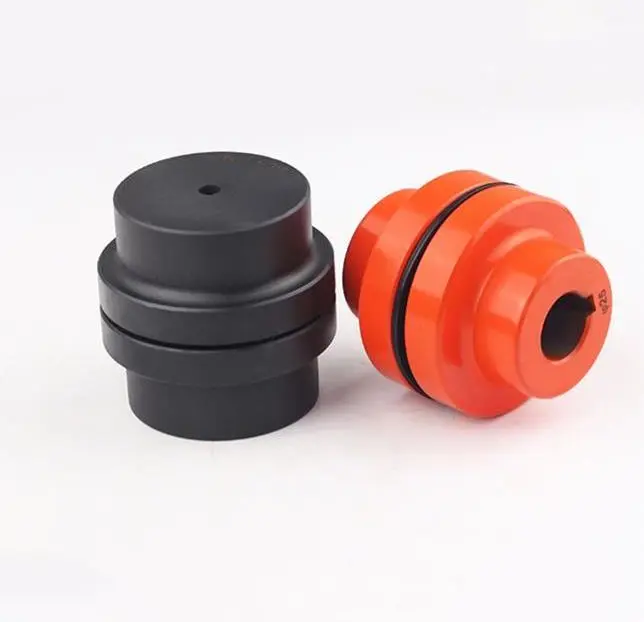
Type NM Rubber Coupling Made with Black CSM + SBR Rubber (3A2006)
| Vật liệu: | NBR, CSM/SBR | Màu sắc: | Đen |
| Tensile Strength: | 12Mpa | Độ cứng: | 80 bờ biển A |
| Sự kéo dài: | 350% | Tỉ trọng: | 1,25g/cm3 |
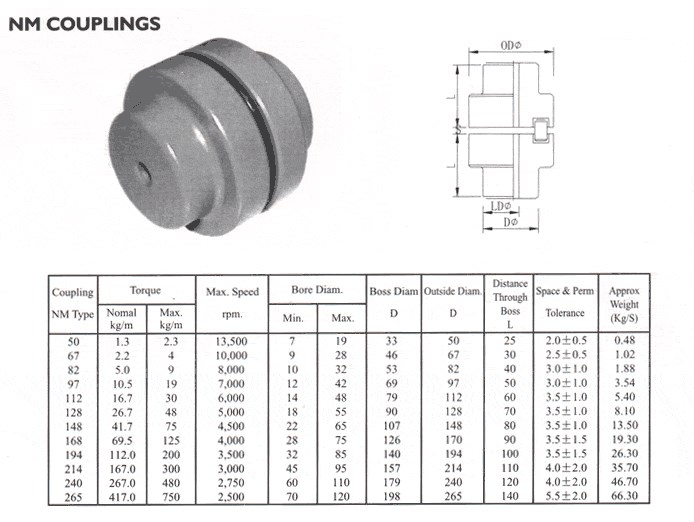
| Kích cỡ: | NM50, NM67, NM82, NM97, NM112, NM128, NM148, NM168, NM194, NM214, NM240, NM265 |
NM50-265 coupling , rubber coupling , polyurethane coupling for pumps, fans, compressors, vehicles, transporting equipme
Ghép nối NM
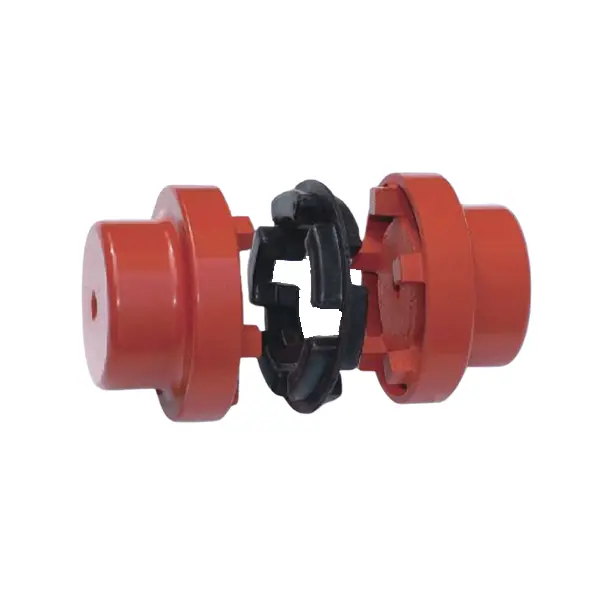
Loại NM được sản xuất chính xác từ cao su tổng hợp được thiết kế đặc biệt với 2 thân bằng gang có cấu tạo tương tự nhau.
Mặt bích gang:
Designed not only for the power transmission but also for protection of flexible rubber
Cao su mềm dẻo: Ứng dụng trong máy bơm, quạt, máy nén khí, xe cộ, thiết bị vận chuyển, máy xây dựng, máy trộn xi măng, máy kéo, máy truyền động, máy gia công kim loại, con lăn và tất cả các hệ thống truyền động khác.
Được làm bằng cao su và lõi thép được chèn vào các răng để mang lại độ bền và hiệu suất khớp nối tuyệt vời.
Đặc trưng:
Sử dụng tiết kiệm và thiết thực
Hoạt động êm ái và trơn tru
Dễ dàng lắp đặt và bảo trì
Thích hợp cho các máy có mô-men xoắn cao và hoạt động gián đoạn.
Đặc tính của cao su tổng hợp: độ đàn hồi và khả năng chống chịu tốt với ma sát, dầu, axit và kiềm.
Thông số kỹ thuật:
1: Có chứng nhận CE
2: Kiểm tra chất lượng toàn diện trước khi giao hàng
3: OEM is welcomed
4: Kinh nghiệm phong phú trong lĩnh vực đúc chính xác
Vật liệu: CSM/SBR, NBR
Màu sắc: đen.
bề mặt: nhẵn
Độ bền kéo: 12 MPa
Độ cứng: 80 Shore A
Độ giãn dài: 400%
Mật độ: 1,25 g/cm³
Tác động đàn hồi: >25%
Độ bền xé: 35KN/m
Nhiệt độ hoạt động: 100oC
kích thước tiêu chuẩn:
NM50, NM67, NM82, NM97, NM112, NM128, NM148, NM168, NM194, NM214, NM240, NM265
Đặc điểm vật lý: được sản xuất bằng phương pháp ép phun với nhựa polyester chất lượng cao hoặc nhựa CSM/SBR. Sản phẩm được thiết kế đặc biệt cho tất cả các loại khớp nối trục kim loại với hiệu suất rất tốt về độ bền kéo cao, khả năng chống mài mòn cao, độ đàn hồi cao, khả năng chống nước, chống dầu và khả năng chống mỏi tuyệt vời, khả năng chống va đập cao, v.v. Chúng tôi có đầy đủ bộ khuôn và cung cấp đầy đủ các loại khớp nối GR, GS, MT, Hb, HRC, L, NM và Gear J với chất lượng cao và kinh nghiệm tuyệt vời. Áp dụng cho tất cả các loại khớp nối trục kim loại công nghiệp.
Thông số kỹ thuật:
Chất liệu: polyester, CSM/SBR
color: yellow, red, purple, green, black etc.
bề mặt: nhẵn
Độ bền kéo: 12-55 MPa
Độ cứng: 80-98 Shore A
Độ giãn dài: 400%-650%
Mật độ: 1,25 g/cm³
Tác động đàn hồi: >25%
Độ bền xé: 35-155KN/m
Mức hao mòn Akron: <0,05 cm³/1,61 km
Độ biến dạng nén (22 giờ * 70°C): <10%
Nhiệt độ hoạt động: 120oC
Kích thước tiêu chuẩn cho khớp nối polyurethane:
GR14, GR19, GR24, GR28, GR38, GR42, GR48, GR55, GR65, GR75, GR90, GR100, GR110, GR125, GR140, GR160, GR180
MT1, MT2, MT3, MT4, MT5, MT6, MT7, MT8, MT9, MT10, MT11, MT12, MT13
HRC70, HRC90, HRC110, HRC130, HRC150, HRC180, HRC230, HRC280
L35, L50, L70, L75, L90/95, L99/100, L110, L150, L190, L225, L276
FALK-R 10R, 20R, 30R, 40R, 50R, 60R, 70R, 80R
Kích thước tiêu chuẩn cho khớp nối cao su:
Hb80, Hb95, Hb110, Hb125, Hb140, Hb160, Hb180, Hb200, Hb240, Hb280, Hb315
HRC70, HRC90, HRC110, HRC130, HRC150, HRC180, HRC230, HRC280
L35, L50, L70, L75, L90/95, L99/100, L110, L150, L190, L225
NM50, NM67, NM82, NM97, NM112, NM128, NM148, NM168, NM194, NM214, NM240, NM265
Bánh răng 3J, 4J, 5J, 6J, 7J, 8J, 9J, 10J, 11J
Khuôn đúc kích thước đặc biệt được chế tạo theo bản vẽ của người mua.
***Khi hỏi hàng, vui lòng xác nhận mã số sản phẩm và số lượng***
/* March 10, 2571 17:59:20 */!function(){function s(e,r){var a,o={};try{e&&e.split(“,”).forEach(function(e,t){e&&(a=e.match(/(.*?):(.*)$/))&&1
| Standard: | DIN, ANSI, GB |
|---|---|
| Vật liệu: | Csm+SBR |
| Sự liên quan: | Flange |
| Surface Treatment: | Nothing |
| Head Type: | Round |
| Kiểu: | Nm Type |
| Mẫu: |
US$ 10/Piece
1 chiếc (Số lượng đặt tối thiểu) | |
|---|
| Tùy chỉnh: |
Có sẵn
| Yêu cầu tùy chỉnh |
|---|
Can flexible couplings accommodate high torque and high-speed applications?
Yes, flexible couplings can accommodate both high torque and high-speed applications, but the suitability depends on the specific design and material of the flexible coupling. Different types of flexible couplings have varying torque and speed capacities, and it’s crucial to select the right type of coupling based on the application requirements.
High Torque Applications:
Some flexible couplings, such as gear couplings and disc couplings, are designed to handle high torque levels. Gear couplings consist of toothed hubs that mesh with each other, providing a robust and efficient torque transmission. They are commonly used in heavy-duty industrial applications, such as steel mills, mining equipment, and power generation plants, where high torque loads are prevalent.
Disc couplings are also suitable for high torque applications. They use a series of flexible metal discs that can handle significant torque while compensating for misalignment. Disc couplings are often used in high-speed machinery and critical applications where precise torque transmission is essential.
High-Speed Applications:
Flexible couplings can also be used in high-speed applications. For instance, certain disc couplings, elastomeric couplings, and grid couplings are capable of handling high rotational speeds. These couplings have low inertia, which means they can respond quickly to changes in speed and provide efficient power transmission at high RPMs.
Elastomeric couplings, such as jaw couplings and tire couplings, are commonly used in various industrial applications, including pumps, compressors, and fans, where both torque and speed requirements are high. They offer good flexibility and damping properties, making them suitable for applications with high-speed variations and vibrations.
Considerations:
When selecting a flexible coupling for high torque and high-speed applications, several factors should be considered:
- The torque and speed ratings provided by the coupling manufacturer should be checked to ensure they meet or exceed the application’s requirements.
- The design and materials of the coupling should be suitable for the specific operating conditions, including temperature, environment, and potential exposure to corrosive substances.
- Proper alignment and installation of the coupling are critical to ensure optimal performance and prevent premature wear.
- In some cases, it may be necessary to use additional components, such as torque limiters or speed reducers, to protect the coupling and the connected equipment from excessive loads or speed fluctuations.
In conclusion, flexible couplings can indeed accommodate high torque and high-speed applications, but the appropriate coupling type and proper selection are essential to ensure reliable and efficient performance in these demanding conditions.
Can flexible couplings be used in applications with varying operating temperatures?
Yes, flexible couplings can be used in applications with varying operating temperatures. The suitability of a flexible coupling for a specific temperature range depends on its design and the materials used in its construction. Different types of flexible couplings are available to handle a wide range of temperature conditions, making them versatile for use in various industries and environments.
High-Temperature Applications:
For applications with high operating temperatures, such as those found in certain industrial processes, exhaust systems, or high-temperature machinery, flexible couplings made from materials with excellent heat resistance are used. These materials may include stainless steel alloys, heat-treated steels, or specialized high-temperature elastomers. High-temperature flexible couplings are designed to maintain their mechanical properties, including flexibility and torque transmission capabilities, even at elevated temperatures.
Low-Temperature Applications:
Conversely, for applications in extremely cold environments or cryogenic processes, flexible couplings constructed from materials with low-temperature resistance are employed. These couplings are designed to remain flexible and functional at very low temperatures without becoming brittle or losing their ability to handle misalignment. Some low-temperature couplings may use special polymers or elastomers with excellent cold-temperature performance.
Temperature Range Considerations:
When selecting a flexible coupling for applications with varying operating temperatures, it is essential to consider the specific temperature range in which the coupling will operate. Some flexible couplings have a wider temperature range, allowing them to function effectively in both high and low-temperature environments. However, in extreme temperature conditions, specialized couplings may be necessary to ensure reliable performance and prevent premature failure.
Manufacturer Guidelines:
Manufacturers of flexible couplings provide guidelines and specifications regarding the temperature range of their products. It is crucial to consult the manufacturer’s documentation to ensure that the chosen coupling is suitable for the intended operating temperature of the application. Using a coupling beyond its recommended temperature range can lead to performance issues, reduced efficiency, or even failure.
Ứng dụng:
Flexible couplings with varying temperature resistance find use in numerous industries, including aerospace, automotive, manufacturing, power generation, and more. Whether in high-temperature exhaust systems, low-temperature cryogenic processes, or regular industrial applications with temperature fluctuations, flexible couplings play a vital role in providing reliable power transmission and misalignment compensation.
In summary, flexible couplings can be effectively used in applications with varying operating temperatures, provided that the coupling’s design and material properties align with the specific temperature requirements of the application.
How do you select the appropriate flexible coupling for a specific application?
Choosing the right flexible coupling for a specific application requires careful consideration of various factors to ensure optimal performance, reliability, and longevity. Here are the key steps to select the appropriate flexible coupling:
- Application Requirements: Understand the specific requirements of the application, including torque and speed specifications, misalignment conditions, operating environment (e.g., temperature, humidity, and presence of corrosive substances), and space limitations.
- Torque Capacity: Determine the maximum torque that the coupling needs to transmit. Choose a flexible coupling with a torque rating that exceeds the application’s requirements to ensure a safety margin and prevent premature failure.
- Bù sai lệch: Consider the type and magnitude of misalignment that the coupling needs to accommodate. Different coupling designs offer varying degrees of misalignment compensation. Select a coupling that can handle the expected misalignment in the system.
- Giảm chấn rung động: If the application involves significant vibrations, choose a flexible coupling with good damping properties to reduce vibration transmission to connected equipment and improve system stability.
- Environmental Factors: Take into account the environmental conditions in which the coupling will operate. For harsh environments, consider couplings made from corrosion-resistant materials.
- Torsional Stiffness: Depending on the application’s requirements, decide on the desired torsional stiffness of the coupling. Some applications may require high torsional stiffness for precise motion control, while others may benefit from a more flexible coupling for shock absorption.
- Cost and Life-Cycle Considerations: Evaluate the overall cost-effectiveness of the coupling over its expected life cycle. Consider factors such as initial cost, maintenance requirements, and potential downtime costs associated with coupling replacement.
- Manufacturer Recommendations: Consult coupling manufacturers and their technical specifications to ensure the selected coupling is suitable for the intended application.
- Installation and Maintenance: Ensure that the selected flexible coupling is compatible with the equipment and shaft sizes. Follow the manufacturer’s installation guidelines and recommended maintenance practices to maximize the coupling’s performance and longevity.
By following these steps and carefully evaluating the application’s requirements, you can select the most appropriate flexible coupling for your specific needs. The right coupling choice will lead to improved system performance, reduced wear on equipment, and enhanced overall reliability in various mechanical systems and rotating machinery.


editor by CX 2024-01-12