Produktbeskrivning
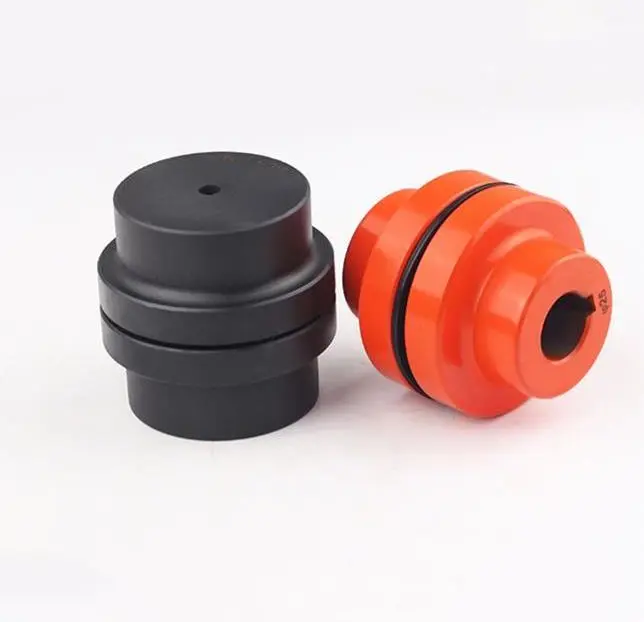
Type NM Rubber Coupling Made with Black CSM + SBR Rubber (3A2006)
| Material: | NBR, CSM/SBR | Färg: | Svart |
| Tensile Strength: | 12 MPa | Hårdhet: | 80 shore A |
| Förlängning: | 350% | Densitet: | 1,25 g/cm3 |
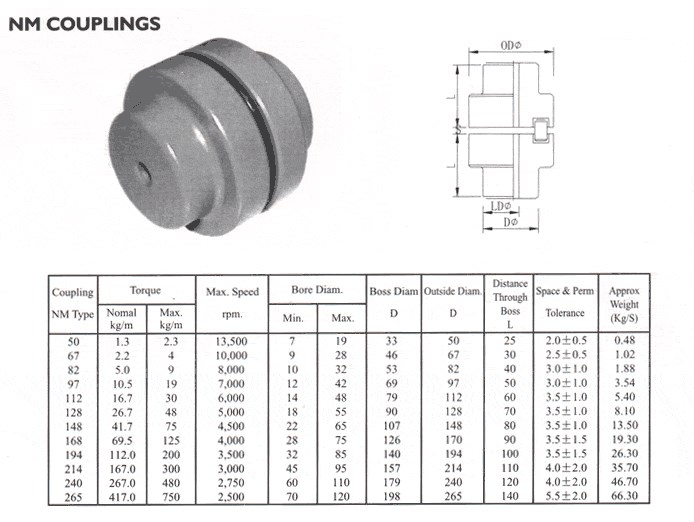
| Storlek: | NM50, NM67, NM82, NM97, NM112, NM128, NM148, NM168, NM194, NM214, NM240, NM265 |
NM50-265 coupling , rubber coupling , polyurethane coupling for pumps, fans, compressors, vehicles, transporting equipme
NM-koppling
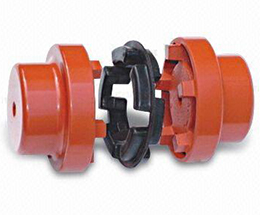
NM-typen är exakt producerad av ett specialdesignat syntetiskt gummi med två liknande gjutjärnskroppar
Gjutjärnsflänsar:
Designed not only for the power transmission but also for protection of flexible rubber
Flexibelt gummi: Används för pumpar, fläktar, kompressorer, fordon, transportutrustning, byggföretag, cementblandare, traktorer, transmissionsmaskiner, metallbearbetningsmaskiner, vältar och alla andra transmissioner.
Tillverkad av gummi och stålkärnor är insatta i tänderna för att ge utmärkt hållbarhet och kopplingsprestanda
Drag:
Ekonomisk och praktisk användning
Tyst och smidig drift
Enkel installation och underhåll
Tillgänglig för maskiner med högt vridmoment och intermittent drift
Egenskaper hos syntetiskt gummi: god elasticitet och motståndskraft mot dämpning, olja, syror och alkalier
Specifikationer:
1: med CE-certifikat
2: fullständig kvalitetskontroll före leverans
3: OEM is welcomed
4: rik erfarenhet av precisionsgjutning
material: CSM/SBR, NBR
färg: svart.
yta: slät
draghållfasthet: 12 MPa
hårdhet: 80 Shore A
förlängning: 400%
densitet: 1,25 g/cm3
elasticitetspåverkan: >25%
rivstyrka: 35 kN/m²
arbetstemperatur: 100°C
standardstorlek:
NM50, NM67, NM82, NM97, NM112, NM128, NM148, NM168, NM194, NM214, NM240, NM265
Fysisk karaktär: Tillverkad genom formsprutning med högkvalitativ polyester eller gjutform CSM/SBR. Den är designad och speciell för alla typer av metallaxelkopplingar med mycket goda prestanda vad gäller hög draghållfasthet, hög slitstyrka, hög elastisk motståndskraft, vattenbeständighet, oljebeständighet och utmärkt utmattningsbeständighet, hög slagtålighet etc. Vi har kompletta formar och levererar ett komplett sortiment av GR-, GS-, MT-, Hb-, HRC-, L-, NM- och Gear J-seriekopplingar med hög kvalitet och utmärkt erfarenhet. Tillämpas på alla typer av industriella metallaxelkopplingar.
Specifikationer:
material: polyester, CSM/SBR
color: yellow, red, purple, green, black etc.
yta: slät
draghållfasthet: 12-55 MPa
hårdhet: 80-98 Shore A
förlängning: 400%-650%
densitet: 1,25 g/cm3
elasticitetspåverkan: >25%
rivstyrka: 35-155 kN/m²
CHINAMFG abrasion loss: <0.05cm3/1.61km
kompressionssättning (22 timmar * 70 °C): <10%
arbetstemperatur: 120°C
Standardstorlek för polyuretankoppling:
GR14, GR19, GR24, GR28, GR38, GR42, GR48, GR55, GR65, GR75, GR90, GR100, GR110, GR125, GR140, GR160, GR180
MT1, MT2, MT3, MT4, MT5, MT6, MT7, MT8, MT9, MT10, MT11, MT12, MT13
HRC70, HRC90, HRC110, HRC130, HRC150, HRC180, HRC230, HRC280
L35, L50, L70, L75, L90/95, L99/100, L110, L150, L190, L225, L276
FALK-R 10R, 20R, 30R, 40R, 50R, 60R, 70R, 80R
Standardstorlek för gummikoppling:
Hb80, Hb95, Hb110, Hb125, Hb140, Hb160, Hb180, Hb200, Hb240, Hb280, Hb315
HRC70, HRC90, HRC110, HRC130, HRC150, HRC180, HRC230, HRC280
L35, L50, L70, L75, L90/95, L99/100, L110, L150, L190, L225
NM50, NM67, NM82, NM97, NM112, NM128, NM148, NM168, NM194, NM214, NM240, NM265
Växel 3J, 4J, 5J, 6J, 7J, 8J, 9J, 10J, 11J
specialdimensionerad bygggjutning enligt köparens ritningar
***När du gör en förfrågan, vänligen bekräfta produktens nummer och kvantitet***
/* 22 januari 2571 19:08:37 */!function(){function s(e,r){var a,o={};try{e&&e.split(“,”).forEach(function(e,t){e&&(a=e.match(/(.*?):(.*)$/)))
| Standard: | DIN, ANSI, GB |
|---|---|
| Material: | Csm+SBR |
| Connection: | Flange |
| Surface Treatment: | Nothing |
| Head Type: | Round |
| Typ: | Nm Type |
| Prover: |
US$ 10/Piece
1 styck (minsta beställning) | |
|---|
| Anpassning: |
Tillgänglig
| Anpassad förfrågan |
|---|
Kan flexibla kopplingar hantera applikationer med högt vridmoment och hög hastighet?
Ja, flexibla kopplingar kan hantera både höga vridmoment- och höghastighetsapplikationer, men lämpligheten beror på den specifika designen och materialet hos den flexibla kopplingen. Olika typer av flexibla kopplingar har varierande vridmoment- och hastighetskapacitet, och det är avgörande att välja rätt typ av koppling baserat på applikationskraven.
Applikationer med högt vridmoment:
Vissa flexibla kopplingar, såsom kugghjulskopplingar och skivkopplingar, är konstruerade för att hantera höga vridmomentnivåer. Kugghjulskopplingar består av tandade nav som griper in i varandra, vilket ger en robust och effektiv momentöverföring. De används ofta i tunga industriella applikationer, såsom stålverk, gruvutrustning och kraftverk, där höga vridmomentbelastningar är vanliga.
Skivkopplingar är också lämpliga för applikationer med högt vridmoment. De använder en serie flexibla metallskivor som kan hantera betydande vridmoment samtidigt som de kompenserar för feljustering. Skivkopplingar används ofta i höghastighetsmaskiner och kritiska applikationer där exakt momentöverföring är avgörande.
Höghastighetsapplikationer:
Flexibla kopplingar kan också användas i höghastighetsapplikationer. Till exempel kan vissa skivkopplingar, elastomerkopplingar och gallerkopplingar hantera höga rotationshastigheter. Dessa kopplingar har låg tröghet, vilket innebär att de kan reagera snabbt på hastighetsförändringar och ge effektiv kraftöverföring vid höga varvtal.
Elastomera kopplingar, såsom käftkopplingar och däckkopplingar, används ofta i olika industriella tillämpningar, inklusive pumpar, kompressorer och fläktar, där både vridmoment- och hastighetskraven är höga. De erbjuder god flexibilitet och dämpningsegenskaper, vilket gör dem lämpliga för tillämpningar med höga hastighetsvariationer och vibrationer.
Överväganden:
När man väljer en flexibel koppling för applikationer med högt vridmoment och hög hastighet bör flera faktorer beaktas:
- Vridmoment- och hastighetsvärdena som anges av kopplingstillverkaren bör kontrolleras för att säkerställa att de uppfyller eller överträffar tillämpningens krav.
- Kopplingens konstruktion och material ska vara lämpliga för de specifika driftsförhållandena, inklusive temperatur, miljö och potentiell exponering för frätande ämnen.
- Korrekt inriktning och installation av kopplingen är avgörande för att säkerställa optimal prestanda och förhindra för tidigt slitage.
- I vissa fall kan det vara nödvändigt att använda ytterligare komponenter, såsom momentbegränsare eller hastighetsreducerare, för att skydda kopplingen och den anslutna utrustningen från överdrivna belastningar eller hastighetsfluktuationer.
Sammanfattningsvis kan flexibla kopplingar verkligen hantera applikationer med högt vridmoment och höga hastigheter, men rätt kopplingstyp och korrekt val är avgörande för att säkerställa tillförlitlig och effektiv prestanda under dessa krävande förhållanden.
How does a flexible coupling impact the overall reliability of connected equipment?
A flexible coupling significantly impacts the overall reliability of connected equipment in several ways:
- Feljusteringskompensation: Flexible couplings can accommodate both angular and parallel misalignment between connected shafts. By allowing for misalignment, the coupling reduces the stress and wear on bearings, seals, and other rotating components. This feature prevents premature failure of these components, contributing to improved reliability and extended equipment lifespan.
- Vibrationsdämpning: Flexible couplings possess inherent damping properties due to their elastomeric or flexible elements. These elements absorb and dissipate vibrations generated during the operation of machinery. By dampening vibrations, the coupling protects the connected equipment from excessive oscillations, reducing fatigue and preventing mechanical failures. This enhanced vibration control increases the reliability of the system.
- Shock Load Absorption: In applications with sudden load variations or shock loads, such as in heavy machinery or high-speed equipment, a flexible coupling acts as a shock absorber. It can absorb and dissipate the impact energy, protecting the machinery from damage caused by sudden loads. The ability to absorb shock loads contributes to the overall reliability of the connected equipment.
- Reduced Wear and Tear: The flexibility of the coupling minimizes stress and wear on rotating equipment. It allows for slight movements and misalignments, reducing friction and stress on bearings and other critical components. This reduction in wear and tear lowers the frequency of maintenance and replacement, increasing the overall reliability of the equipment.
- Compensation for Thermal Expansion: Temperature changes in machinery can lead to thermal expansion or contraction of shafts. A flexible coupling can compensate for these thermal effects, ensuring that the machinery remains properly aligned even as temperature conditions fluctuate. This compensation prevents binding and misalignment, promoting reliable performance.
- Protection Against Overloads: Flexible couplings help protect connected equipment from overloads and torsional vibrations. They act as a mechanical fuse, disconnecting the driveline when an overload occurs, thus preventing damage to expensive machinery. This safety feature enhances the overall reliability and reduces the risk of catastrophic failures.
- Easy Maintenance and Alignment: Flexible couplings are designed for easy installation and alignment. This feature simplifies maintenance procedures, making it easier to inspect and replace couplings when necessary. Properly aligned couplings lead to improved equipment performance and longevity, enhancing overall reliability.
By compensating for misalignment, damping vibrations, absorbing shock loads, reducing wear and tear, and providing other protective features, a flexible coupling significantly improves the reliability of connected equipment. It extends the lifespan of critical components, minimizes downtime, and ensures smooth and efficient operation, making it a valuable component in various industrial applications.
Can flexible couplings handle misalignment between shafts?
Yes, flexible couplings are specifically designed to handle misalignment between shafts in rotating machinery and mechanical systems. Misalignment can occur due to various factors, including installation errors, thermal expansion, manufacturing tolerances, or shaft deflection during operation.
Flexible couplings offer the ability to compensate for different types of misalignment, including:
- Angular Misalignment: When the shafts are not collinear and have an angular offset, flexible couplings can accommodate this misalignment by flexing or twisting, allowing the two shafts to remain connected while transmitting torque smoothly.
- Parallel Misalignment: Parallel misalignment occurs when the two shafts are not perfectly aligned along their axes. Flexible couplings can adjust to this misalignment, ensuring that the shafts remain connected and capable of transmitting power efficiently.
- Axial Misalignment: Axial misalignment, also known as end float or axial displacement, refers to the relative axial movement of the two shafts. Some flexible coupling designs can accommodate axial misalignment, allowing for slight axial movements without disengaging the coupling.
The ability of flexible couplings to handle misalignment is essential in preventing premature wear and failure of the connected equipment. By compensating for misalignment, flexible couplings reduce the stress on the shafts, bearings, and seals, extending the service life of these components and improving overall system reliability.
It is crucial to select the appropriate type of flexible coupling based on the specific misalignment requirements of the application. Different coupling designs offer varying degrees of misalignment compensation, and the choice depends on factors such as the magnitude and type of misalignment, the torque requirements, and the operating environment.
In summary, flexible couplings play a vital role in handling misalignment between shafts, ensuring efficient power transmission and protecting mechanical systems from the adverse effects of misalignment. Their ability to accommodate misalignment makes them indispensable components in various industrial, automotive, aerospace, and marine applications.


editor by CX 2024-04-09