Productbeschrijving
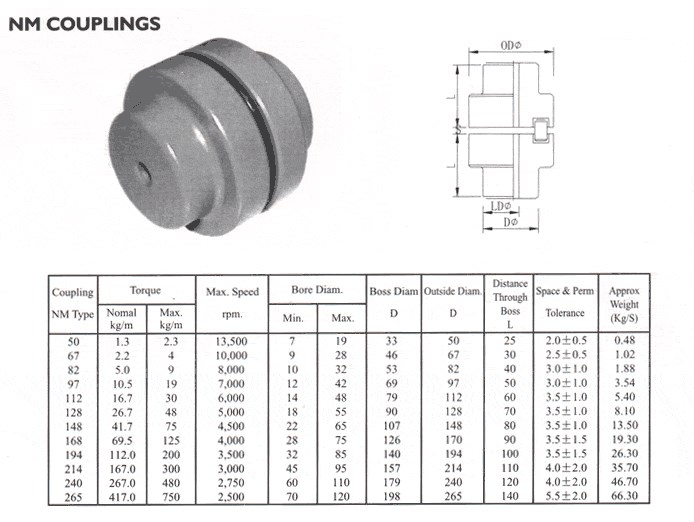
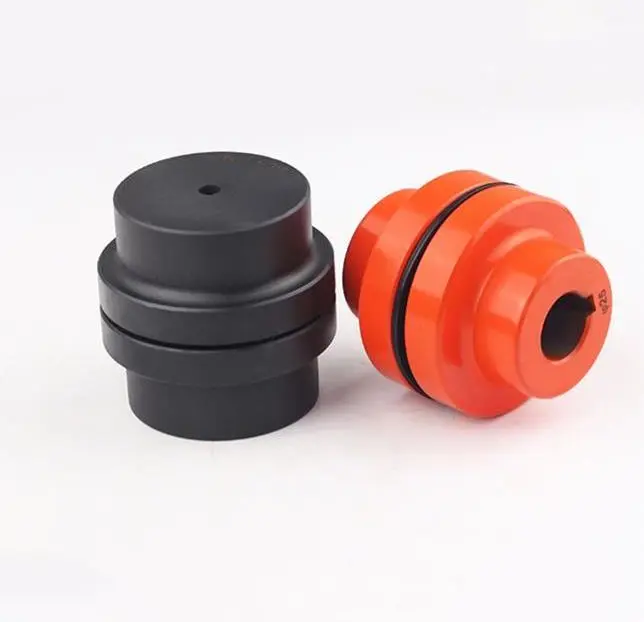
Type NM Rubber Coupling Made with Black CSM + SBR Rubber (3A2006)
| Materiaal: | NBR, CSM/SBR | Kleur: | Black |
| Tensile Strength: | 12Mpa | Hardness: | 80shore A |
| Elongation: | 350% | Density: | 1.25g/cm3 |
| Size: | NM50, NM67, NM82, NM97, NM112, NM128, NM148, NM168, NM194, NM214, NM240, NM265 |
NM50-265 coupling , rubber coupling , polyurethane coupling for pumps, fans, compressors, vehicles, transporting equipme
NM coupling
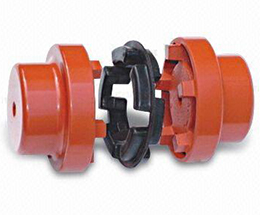
NM type is precisely produced by a special designed synthetic rubber with 2 similar bodies of cast iron
Cast iron flanges:
Designed not only for the power transmission but also for protection of flexible rubber
Flexible rubber:Applications for pumps, fans, compressors, vehicles, transporting equipments, constructors, cement mixers, tractors, transmission machines, metal working machines, rollers and all other transmissions
Made of rubber and steel cores are inserted in the teeth so as to provide excellent durability and performance of coupling
Features:
Economical and practical using
Quiet and smooth operation
Easy installation and maintenance
Available to machines with high torque and intermittent operation
Characteristics of the synthetic rubber: proper elasticity and resistance to damping, oil, acids and alkalie
Specifications:
1: with CE certificate
2: full detection of quality before delivery
3: OEM is welcomed
4: rich experience in precision casting
material: CSM/SBR, NBR
color: black.
surface: smooth
tensile strength: 12Mpa
hardness: 80Shore A
elongation: 400%
density: 1.25g/cm3
elasticity impact: >25%
tear strength: 35KN/m
working temperature: 100oC
standard size:
NM50, NM67, NM82, NM97, NM112, NM128, NM148, NM168, NM194, NM214, NM240, NM265
Physical character: made by injection with high quality polyester or mould CSM/SBR. It is designing and special for all kinds of metal shaft coupling with very good performance of high tensile strength, high wear resistant, high elastic resilience, water resistant, oil resistant and excellent fatigue resilience, high impact resistant etc. We have full sets moulds and supply full range of GR, GS, MT, Hb, HRC, L, NM and Gear J series couplings with high quality and excellent experience. Apply to all kinds of industrial metal shaft coupling.
Specifications:
material: polyester, CSM/SBR
color: yellow, red, purple, green, black etc.
surface: smooth
tensile strength: 12-55Mpa
hardness: 80-98Shore A
elongation: 400%-650%
density: 1.25g/cm3
elasticity impact: >25%
tear strength: 35-155KN/m
CHINAMFG abrasion loss: <0.05cm3/1.61km
compression set (22h*70oC): <10%
working temperature: 120oC
standard size for polyurethane coupling:
GR14, GR19, GR24, GR28, GR38, GR42, GR48, GR55, GR65, GR75, GR90, GR100, GR110, GR125, GR140, GR160, GR180
MT1, MT2, MT3, MT4, MT5, MT6, MT7, MT8, MT9, MT10, MT11, MT12, MT13
HRC70, HRC90, HRC110, HRC130, HRC150, HRC180, HRC230, HRC280
L35, L50, L70, L75, L90/95, L99/100, L110, L150, L190, L225, L276
FALK-R 10R, 20R, 30R, 40R, 50R, 60R, 70R, 80R
standard size for rubber coupling:
Hb80, Hb95, Hb110, Hb125, Hb140, Hb160, Hb180, Hb200, Hb240, Hb280, Hb315
HRC70, HRC90, HRC110, HRC130, HRC150, HRC180, HRC230, HRC280
L35, L50, L70, L75, L90/95, L99/100, L110, L150, L190, L225
NM50, NM67, NM82, NM97, NM112, NM128, NM148, NM168, NM194, NM214, NM240, NM265
Gear 3J, 4J, 5J, 6J, 7J, 8J, 9J, 10J, 11J
special size build molding according to the buyer’s drawings
***when you enquiry, pls confirm product’s number and quantity***
/* 22 januari 2571 19:08:37 */!function(){function s(e,r){var a,o={};try{e&&e.split(“,”).forEach(function(e,t){e&&(a=e.match(/(.*?):(.*)$/))&&1
| Standard: | DIN, ANSI, GB |
|---|---|
| Materiaal: | Csm+SBR |
| Connection: | Flange |
| Surface Treatment: | Nothing |
| Head Type: | Round |
| Type: | Nm Type |
| Voorbeelden: |
US$ 10/stuk
1 stuk (minimale bestelling) | |
|---|
| Aanpassing: |
Beschikbaar
| Aanvraag op maat |
|---|
Can flexible couplings accommodate high torque and high-speed applications?
Yes, flexible couplings can accommodate both high torque and high-speed applications, but the suitability depends on the specific design and material of the flexible coupling. Different types of flexible couplings have varying torque and speed capacities, and it’s crucial to select the right type of coupling based on the application requirements.
High Torque Applications:
Some flexible couplings, such as gear couplings and disc couplings, are designed to handle high torque levels. Gear couplings consist of toothed hubs that mesh with each other, providing a robust and efficient torque transmission. They are commonly used in heavy-duty industrial applications, such as steel mills, mining equipment, and power generation plants, where high torque loads are prevalent.
Disc couplings are also suitable for high torque applications. They use a series of flexible metal discs that can handle significant torque while compensating for misalignment. Disc couplings are often used in high-speed machinery and critical applications where precise torque transmission is essential.
High-Speed Applications:
Flexible couplings can also be used in high-speed applications. For instance, certain disc couplings, elastomeric couplings, and grid couplings are capable of handling high rotational speeds. These couplings have low inertia, which means they can respond quickly to changes in speed and provide efficient power transmission at high RPMs.
Elastomeric couplings, such as jaw couplings and tire couplings, are commonly used in various industrial applications, including pumps, compressors, and fans, where both torque and speed requirements are high. They offer good flexibility and damping properties, making them suitable for applications with high-speed variations and vibrations.
Considerations:
When selecting a flexible coupling for high torque and high-speed applications, several factors should be considered:
- The torque and speed ratings provided by the coupling manufacturer should be checked to ensure they meet or exceed the application’s requirements.
- The design and materials of the coupling should be suitable for the specific operating conditions, including temperature, environment, and potential exposure to corrosive substances.
- Proper alignment and installation of the coupling are critical to ensure optimal performance and prevent premature wear.
- In some cases, it may be necessary to use additional components, such as torque limiters or speed reducers, to protect the coupling and the connected equipment from excessive loads or speed fluctuations.
In conclusion, flexible couplings can indeed accommodate high torque and high-speed applications, but the appropriate coupling type and proper selection are essential to ensure reliable and efficient performance in these demanding conditions.
Welke invloed heeft een flexibele koppeling op de algehele betrouwbaarheid van aangesloten apparatuur?
Een flexibele koppeling heeft op verschillende manieren een aanzienlijke invloed op de algehele betrouwbaarheid van aangesloten apparatuur:
- Compensatie voor verkeerde uitlijning: Flexibele koppelingen kunnen zowel hoek- als parallelle uitlijningsfouten tussen de aangesloten assen opvangen. Door deze uitlijningsfouten toe te staan, vermindert de koppeling de belasting en slijtage van lagers, afdichtingen en andere roterende onderdelen. Deze eigenschap voorkomt voortijdige slijtage van deze onderdelen, wat bijdraagt aan een verbeterde betrouwbaarheid en een langere levensduur van de apparatuur.
- Trillingsdemping: Flexibele koppelingen beschikken over inherente dempende eigenschappen dankzij hun elastomere of flexibele elementen. Deze elementen absorberen en dempen trillingen die ontstaan tijdens de werking van machines. Door trillingen te dempen, beschermt de koppeling de aangesloten apparatuur tegen overmatige oscillaties, waardoor vermoeidheid wordt verminderd en mechanische storingen worden voorkomen. Deze verbeterde trillingsbeheersing verhoogt de betrouwbaarheid van het systeem.
- Schokbelastingabsorptie: Bij toepassingen met plotselinge belastingsveranderingen of schokbelastingen, zoals bij zware machines of hogesnelheidsapparatuur, fungeert een flexibele koppeling als schokdemper. Deze kan de impactenergie absorberen en afvoeren, waardoor de machine wordt beschermd tegen schade door plotselinge belastingen. Het vermogen om schokbelastingen te absorberen draagt bij aan de algehele betrouwbaarheid van de aangesloten apparatuur.
- Minder slijtage: De flexibiliteit van de koppeling minimaliseert de belasting en slijtage van roterende apparatuur. Het maakt kleine bewegingen en uitlijningsafwijkingen mogelijk, waardoor wrijving en belasting op lagers en andere kritische componenten worden verminderd. Deze vermindering van slijtage verlaagt de frequentie van onderhoud en vervanging, wat de algehele betrouwbaarheid van de apparatuur verhoogt.
- Compensatie voor thermische uitzetting: Temperatuurschommelingen in machines kunnen leiden tot thermische uitzetting of krimp van assen. Een flexibele koppeling kan deze thermische effecten compenseren, waardoor de machine correct uitgelijnd blijft, zelfs bij temperatuurschommelingen. Deze compensatie voorkomt vastlopen en verkeerde uitlijning, wat zorgt voor betrouwbare prestaties.
- Bescherming tegen overbelasting: Flexibele koppelingen beschermen aangesloten apparatuur tegen overbelasting en torsietrillingen. Ze fungeren als een mechanische zekering en onderbreken de aandrijving bij overbelasting, waardoor schade aan dure machines wordt voorkomen. Deze veiligheidsfunctie verhoogt de algehele betrouwbaarheid en verkleint het risico op catastrofale storingen.
- Eenvoudig onderhoud en afstelling: Flexibele koppelingen zijn ontworpen voor eenvoudige installatie en uitlijning. Deze eigenschap vereenvoudigt onderhoudsprocedures, waardoor het gemakkelijker is om koppelingen te inspecteren en indien nodig te vervangen. Goed uitgelijnde koppelingen leiden tot betere prestaties en een langere levensduur van de apparatuur, wat de algehele betrouwbaarheid verhoogt.
Door uitlijningsfouten te compenseren, trillingen te dempen, schokbelastingen op te vangen, slijtage te verminderen en andere beschermende eigenschappen te bieden, verbetert een flexibele koppeling de betrouwbaarheid van aangesloten apparatuur aanzienlijk. Het verlengt de levensduur van kritische componenten, minimaliseert stilstandtijd en zorgt voor een soepele en efficiënte werking, waardoor het een waardevol onderdeel is in diverse industriële toepassingen.
Can flexible couplings handle misalignment between shafts?
Yes, flexible couplings are specifically designed to handle misalignment between shafts in rotating machinery and mechanical systems. Misalignment can occur due to various factors, including installation errors, thermal expansion, manufacturing tolerances, or shaft deflection during operation.
Flexible couplings offer the ability to compensate for different types of misalignment, including:
- Angular Misalignment: When the shafts are not collinear and have an angular offset, flexible couplings can accommodate this misalignment by flexing or twisting, allowing the two shafts to remain connected while transmitting torque smoothly.
- Parallel Misalignment: Parallel misalignment occurs when the two shafts are not perfectly aligned along their axes. Flexible couplings can adjust to this misalignment, ensuring that the shafts remain connected and capable of transmitting power efficiently.
- Axial Misalignment: Axial misalignment, also known as end float or axial displacement, refers to the relative axial movement of the two shafts. Some flexible coupling designs can accommodate axial misalignment, allowing for slight axial movements without disengaging the coupling.
The ability of flexible couplings to handle misalignment is essential in preventing premature wear and failure of the connected equipment. By compensating for misalignment, flexible couplings reduce the stress on the shafts, bearings, and seals, extending the service life of these components and improving overall system reliability.
It is crucial to select the appropriate type of flexible coupling based on the specific misalignment requirements of the application. Different coupling designs offer varying degrees of misalignment compensation, and the choice depends on factors such as the magnitude and type of misalignment, the torque requirements, and the operating environment.
In summary, flexible couplings play a vital role in handling misalignment between shafts, ensuring efficient power transmission and protecting mechanical systems from the adverse effects of misalignment. Their ability to accommodate misalignment makes them indispensable components in various industrial, automotive, aerospace, and marine applications.


editor by CX 2024-04-09