Description du produit
Description du produit
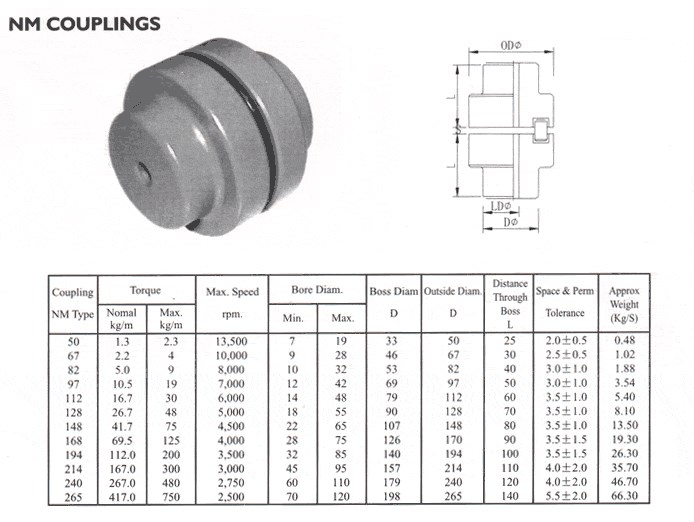
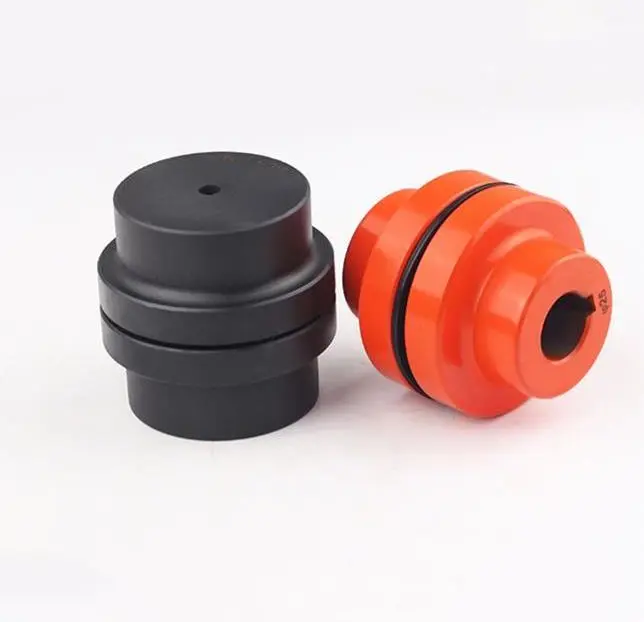
Cast Iron Spider Rubber Flexible NM 128 water pump Shaft coupling
Cast iron NM flexible shaft coupling is a cylindrical pin made of some non-metallic materials, which is placed between the 2 sides of the coupling and the inner surface of the outer ring, and a device to transfer the torque through the column pin to realize the connection between 2 half couplings.
Cast iron NM flexible shaft coupling between the slider made of bakelite cloth or polyurethane, suitable for high speed, large torque, no sharp impact of the 2 connections. The standard code of the pump industry is Bl104. The maximum allowable torque is 850N m, and the maximum shaft diameter is 50mm.
The characteristics of the China Manufactory NM Spider Coupling:
1. It is small in size, light in quality, simple in structure, convenient in installation and low in price. It is often used in small power occasions.
2, the transmission torque is large, and in the same torque, most of the rotary diameter is smaller than the tooth coupling, and it can partly replace the tooth coupling.
3, the inertia force is small, it is suitable for 2 axis connection with little torque, high speed and no sharp impact. The transmission torque of nylon slider is small, but it is more suitable for high-speed operation without lubrication.
Paramètres du produit
Emballage et expédition
All the products can be packed in cartons,or,you can choose the pallet packing.
MADE IN CHINA can be pressed on wooden cases.Land,air,sea transportation are available.UPS,DHL,TNT,
FedEx and EMS are all supported.
Profil de l'entreprise
About Mighty Machinery
ZheJiang Mighty Machinery Co., Ltd., specializes in manufacturing Mechanical Power Transmission Products. After over 13 years hard work, MIGHTY have already get the certificate of ISO9001:2000 and become a holding company for 3 manufacturing factories.
MIGHTY advantage
1, Abundant experience in the mechanical processing industries.
2,Large quality of various material purchase and stock in warhouse which ensure the low cost for the material and production in time.
3,Now have 5 technical staff, we have strong capacity for design and process design, and more than 70 worker now work in our FTY and double shift eveyday.
4,Strick quality control are apply in the whole prodution. we have incoming inspection,process inspection and final production inspection which can ensure the perfect of the goods quality.
5,Long time cooperate with the Global Buyer, make us easy to understand the csutomer and handle the export.
FAQ
Q1 : Êtes-vous une société commerciale ou un fabricant ?
A: Nous sommes une usine.
Q2:Do you provide samples ? is it free or extra ?
A: : Yes, we could offer the sample but not for free.Actually we have a very good price principle, when you make the bulk order then cost of sample will be return to you.
Q3: How long is your delivery time?
A: Generally it is 10-15 days if the goods are in stock. Or it is 7-25 days if the goods are not in stock, it is according to quantity.
Q4:How long is your warranty?
A: Our Warranty is 12 month.
Q5 :Do you have inspection procedures for coupling ?
A:100% self-inspection before packing
Q6. What’s your payment?
A:1) 100% T/T. 2) 30% in advance, others before shipment. 3) L/C Q7:Can I have a visit to your factory before the order? A: Sure,welcome to visit our factory.
| Standard ou non standard : | Standard |
|---|---|
| Couple : | 25-12500(N.M) |
| Vitesse: | 1500-8500(R/M) |
| Structure: | Jaw / Spider |
| Matériel: | Fonte |
| Taper: | Flexible Coupling |
| Exemples : |
US$ 15.9/Piece
1 pièce (commande minimale) | |
|---|
| Personnalisation : |
Disponible
| Demande personnalisée |
|---|
Can flexible couplings accommodate high torque and high-speed applications?
Yes, flexible couplings can accommodate both high torque and high-speed applications, but the suitability depends on the specific design and material of the flexible coupling. Different types of flexible couplings have varying torque and speed capacities, and it’s crucial to select the right type of coupling based on the application requirements.
High Torque Applications:
Some flexible couplings, such as gear couplings and disc couplings, are designed to handle high torque levels. Gear couplings consist of toothed hubs that mesh with each other, providing a robust and efficient torque transmission. They are commonly used in heavy-duty industrial applications, such as steel mills, mining equipment, and power generation plants, where high torque loads are prevalent.
Disc couplings are also suitable for high torque applications. They use a series of flexible metal discs that can handle significant torque while compensating for misalignment. Disc couplings are often used in high-speed machinery and critical applications where precise torque transmission is essential.
High-Speed Applications:
Flexible couplings can also be used in high-speed applications. For instance, certain disc couplings, elastomeric couplings, and grid couplings are capable of handling high rotational speeds. These couplings have low inertia, which means they can respond quickly to changes in speed and provide efficient power transmission at high RPMs.
Elastomeric couplings, such as jaw couplings and tire couplings, are commonly used in various industrial applications, including pumps, compressors, and fans, where both torque and speed requirements are high. They offer good flexibility and damping properties, making them suitable for applications with high-speed variations and vibrations.
Considerations:
When selecting a flexible coupling for high torque and high-speed applications, several factors should be considered:
- The torque and speed ratings provided by the coupling manufacturer should be checked to ensure they meet or exceed the application’s requirements.
- The design and materials of the coupling should be suitable for the specific operating conditions, including temperature, environment, and potential exposure to corrosive substances.
- Proper alignment and installation of the coupling are critical to ensure optimal performance and prevent premature wear.
- In some cases, it may be necessary to use additional components, such as torque limiters or speed reducers, to protect the coupling and the connected equipment from excessive loads or speed fluctuations.
In conclusion, flexible couplings can indeed accommodate high torque and high-speed applications, but the appropriate coupling type and proper selection are essential to ensure reliable and efficient performance in these demanding conditions.
Les raccords flexibles peuvent-ils être utilisés dans des environnements corrosifs ou difficiles ?
Oui, il est possible de concevoir et de sélectionner des accouplements flexibles adaptés aux environnements corrosifs ou difficiles. Le choix des matériaux et des revêtements est crucial pour garantir la durabilité et les performances de l'accouplement dans des conditions exigeantes.
Matériaux résistants à la corrosion :
En milieu corrosif, il est essentiel d'utiliser des matériaux résistants aux agressions chimiques et à l'oxydation. L'acier inoxydable, notamment les nuances 316 ou 17-4 PH, est couramment privilégié pour les raccords flexibles dans ces conditions. Grâce à son excellente résistance à la corrosion, l'acier inoxydable convient parfaitement aux applications où le raccord peut être en contact avec des substances corrosives ou l'humidité.
Revêtements spéciaux :
Dans certains environnements difficiles, les fabricants de raccords peuvent appliquer des revêtements spéciaux pour améliorer leur résistance à la corrosion. Parmi ces revêtements, on peut citer le zingage, le nickelage ou les revêtements époxy. Ces revêtements offrent une protection supplémentaire contre les agents corrosifs et contribuent à prolonger la durée de vie du raccord.
Modèles scellés :
Dans les environnements où le raccord est exposé à des contaminants tels que la poussière, la saleté ou l'humidité, les modèles étanches sont à privilégier. Les raccords flexibles étanches empêchent ces substances de pénétrer dans leurs composants internes, réduisant ainsi les risques de corrosion et d'usure. L'étanchéité contribue également à maintenir les performances du raccord dans le temps, même dans des conditions difficiles.
Applications à haute température :
Dans les environnements difficiles à haute température, on peut utiliser des raccords flexibles fabriqués à partir de matériaux résistants aux hautes températures, tels que certains aciers inoxydables réfractaires ou superalliages. Ces matériaux conservent leurs propriétés mécaniques et leur résistance à la corrosion même à haute température.
Résistance chimique :
Pour les applications où le raccord peut être en contact avec des produits chimiques ou des solvants, il est essentiel de choisir un matériau de raccord chimiquement résistant. Ceci prévient la dégradation et garantit l'intégrité du raccord dans ces environnements.
Conceptions spécialisées :
Dans certains cas, lorsque l'environnement est particulièrement difficile ou unique, des accouplements flexibles conçus sur mesure peuvent s'avérer nécessaires. La conception d'un accouplement adapté aux exigences spécifiques de l'environnement garantit des performances et une fiabilité optimales.
Consultation avec les fabricants :
Pour le choix d'accouplements flexibles destinés à des environnements corrosifs ou difficiles, il est conseillé de consulter les fabricants d'accouplements ou des experts en ingénierie. Ils pourront fournir des informations précieuses et recommander les matériaux, revêtements et conceptions adaptés aux conditions d'utilisation spécifiques.
Résumé:
Les accouplements flexibles peuvent effectivement être utilisés dans des environnements corrosifs ou difficiles, à condition de choisir les matériaux, les revêtements et les conceptions appropriés. L'acier inoxydable, les conceptions étanches et les revêtements spéciaux sont quelques-unes des solutions qui améliorent la résistance à la corrosion et les performances de l'accouplement. Il est essentiel de prendre en compte les exigences spécifiques de l'environnement et de l'application lors du choix d'un accouplement flexible afin de garantir une fonctionnalité et une durabilité optimales dans des conditions difficiles.
What is a flexible coupling and how does it work?
A flexible coupling is a mechanical device used to connect two shafts while allowing for relative movement between them. It is designed to transmit torque from one shaft to another while compensating for misalignment, vibration, and shock. Flexible couplings are essential components in various rotating machinery and systems, as they help protect the connected equipment and enhance overall performance.
Types of Flexible Couplings:
There are several types of flexible couplings, each with its unique design and characteristics. Some common types include:
- Accouplements à mâchoires : Jaw couplings feature elastomer spiders that fit between two hubs. They can accommodate angular and parallel misalignment while dampening vibrations.
- Accouplements à disque : Disc couplings use thin metallic discs to connect the shafts. They are highly flexible and provide excellent misalignment compensation.
- Accouplements d'engrenages : Gear couplings use gear teeth to transmit torque. They offer high torque capacity and can handle moderate misalignment.
- Accouplements de poutres : Beam couplings use a single piece of flexible material, such as a metal beam, to transmit torque while compensating for misalignment.
- Accouplements à soufflets : Bellows couplings use a bellows-like structure to allow for axial, angular, and parallel misalignment compensation.
- Accouplements Oldham : Oldham couplings use three discs, with the middle one having a perpendicular slot to allow for misalignment compensation.
How a Flexible Coupling Works:
The operation of a flexible coupling depends on its specific design, but the general principles are similar. Let’s take the example of a jaw coupling to explain how a flexible coupling works:
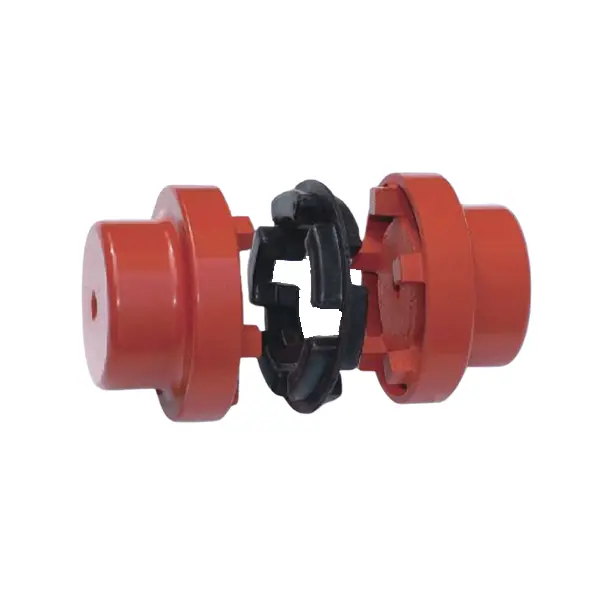
- Two shafts are connected to the coupling hubs on either side, with an elastomer spider placed between them.
- When torque is applied to one shaft, it causes the spider to compress and deform slightly, transmitting the torque to the other shaft.
- In case of misalignment between the shafts, the elastomer spider flexes and compensates for the misalignment, ensuring smooth torque transmission without imposing excessive loads on the shafts or connected equipment.
- The elastomer spider also acts as a damping element, absorbing vibrations and shocks during operation, which reduces wear on the equipment and enhances system stability.
Overall, the flexibility and ability to compensate for misalignment are the key features that allow a flexible coupling to function effectively. The choice of a specific flexible coupling type depends on the application’s requirements, such as torque capacity, misalignment compensation, and environmental conditions.


editor by CX 2023-10-11